Last month, a client — 36, VP at a fintech company — asked me for something I didn’t expect.
Not a diet plan. Not a workout routine. He said: “I’ve been reading about creatine for brain fog. I sit in meetings all afternoon and can’t think straight by 3 PM. Should I take it?”
He’s not a gym bro. He doesn’t care about biceps. He wants his brain to work better at 4 PM the way it does at 10 AM.
And here’s what surprised me: the science is actually on his side.
Creatine Isn’t What You Think It Is
Most people hear “creatine” and picture a jacked guy chugging a shaker bottle at Gold’s Gym. That reputation comes from the 1990s, when bodybuilders discovered that creatine monohydrate helps muscles produce energy faster during high-intensity exercise.
That part is true. But it’s only half the story.
Creatine is a naturally occurring molecule made from three amino acids (arginine, glycine, methionine). Your body produces about 1-2 grams per day in your liver and kidneys. You also get it from food — primarily meat and fish.
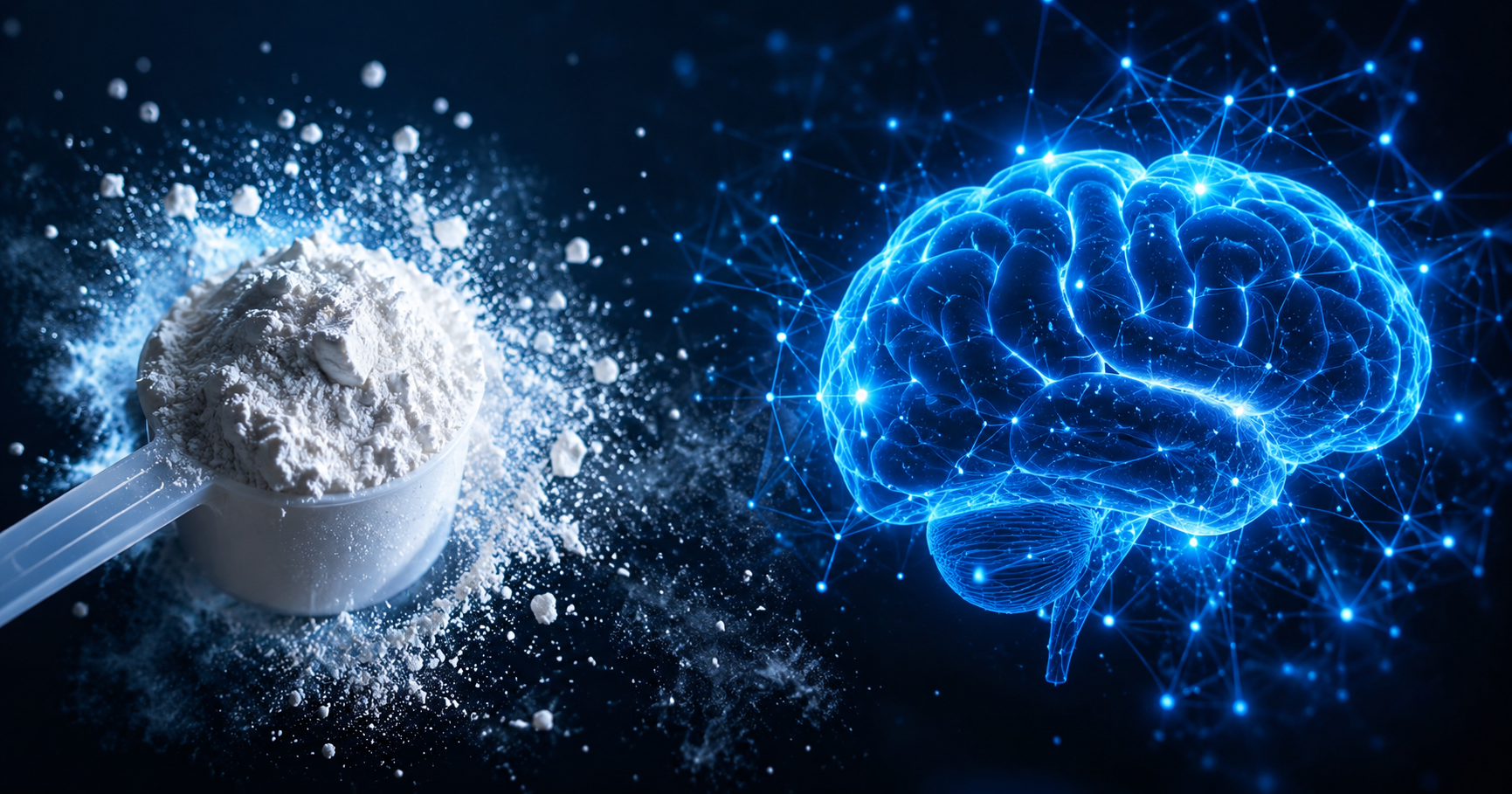
Here’s the part nobody told the gym bros: your brain uses 20% of your body’s total energy, and creatine is one of the fastest ways your brain cells regenerate ATP — the energy currency that powers every thought, decision, and creative idea you have.
Your brain doesn’t just benefit from creatine. It depends on it.
What the Research Actually Shows
This isn’t broscience. The data is remarkably strong.
Sleep deprivation and mental performance
A 2024 study published in Nature Scientific Reports found that a single dose of creatine improved cognitive performance during sleep deprivation — specifically processing speed and executive function. The researchers measured actual brain energy levels using MRI spectroscopy and found that creatine increased phosphocreatine (the brain’s energy reserve) even under sleep-deprived conditions.
Think about that. If you slept 5 hours last night — which 61% of Indians do regularly, according to a 2024 LocalCircles survey — creatine can partially offset the cognitive damage.
Memory and processing speed
A 2024 systematic review in Frontiers in Nutrition examined 16 randomised controlled trials spanning 30 years and concluded that creatine supplementation shows meaningful improvements in short-term memory, reasoning, and processing speed — particularly during metabolically stressful conditions (sleep deprivation, mental fatigue, high cognitive load).
The EFSA stamp
In 2024, the European Food Safety Authority (EFSA) — one of the most rigorous regulatory bodies in the world — evaluated the evidence and approved the health claim that creatine improves cognitive function. This is the same authority that rejects 95% of supplement health claims. They don’t do this lightly.
The Indian Vegetarian Angle (This Is Important)
Here’s where it gets really interesting for us.
Creatine comes from two sources: your body makes some, and you get the rest from meat and fish. Plants contain essentially zero creatine.
Vegetarians have 10-30% lower muscle creatine stores than people who eat meat. That’s well-established across multiple studies.
Now, the brain is a different story. A study in the British Journal of Nutrition using MRI spectroscopy found that vegetarians and omnivores actually have comparable brain creatine levels — the brain appears to protect its own creatine supply through local synthesis.
But here’s the finding that matters: when both groups were given creatine supplements, vegetarians showed significantly greater improvements in memory and processing speed than meat-eaters.
The researchers believe this is because vegetarians’ brains, while maintaining adequate baseline levels, have less “reserve capacity” — so supplementation pushes them into a higher-performing range more dramatically.
For a country where 30-40% of the population is vegetarian, this is a massive insight that almost nobody is talking about.

₹6 Per Day. That’s It.
Unlike most supplements that cost a small fortune, creatine monohydrate is absurdly cheap in India:
- AS-IT-IS Creatine: ₹449 for 250g (~83 servings) = ₹5.4/day
- MuscleBlaze Creatine: ₹599 for 250g = ₹7.2/day
- Wellcore (Creapure, German): Premium option, ~₹12/day
For context, your morning chai at the office canteen probably costs more.
And unlike most supplements, creatine monohydrate has been studied for over 30 years with an excellent safety profile. It’s one of the most researched supplements in human history.
How to Actually Take It
This is simpler than most supplement influencers make it sound.
The dose
3-5 grams per day. That’s it. One teaspoon mixed into water, chai, or a smoothie. No cycling needed. No loading phase required (though loading at 20g/day for 5-7 days saturates your muscles faster — useful if you’re also training).
When to take it
Timing doesn’t matter much. Morning with breakfast, post-workout, or before bed — pick whatever you’ll remember consistently. Consistency matters more than timing.
Which form
Creatine monohydrate. Period. Not creatine HCl, not buffered creatine, not creatine ethyl ester. Monohydrate is the form with 30+ years of research behind it. Everything else is marketing with less evidence and higher prices.
Stay hydrated
Creatine pulls water into your muscle cells (that’s part of how it works). Drink an extra 500ml-1L of water daily. Most Indian professionals are already dehydrated — this is a good habit regardless.
Who Should Consider It
Based on the research, creatine supplementation makes the most sense for:
- Vegetarians and vegans — you’re getting zero dietary creatine, and the cognitive response to supplementation is stronger
- Sleep-deprived professionals — if you regularly get under 7 hours (that’s most of working India), creatine partially offsets the cognitive cost
- Anyone over 30 — creatine synthesis declines with age; supplementation helps maintain both brain and muscle energy reserves
- People in cognitively demanding roles — late-day decision fatigue is real, and creatine helps maintain mental energy through the afternoon
- Anyone doing strength training — the muscle benefits are the most well-established use case; 5-10% strength improvement is typical
Who Should NOT Take It
Creatine is one of the safest supplements available, but it’s not for everyone:
- Anyone with kidney disease — creatine is processed by the kidneys; if your kidney function is compromised, consult your nephrologist first
- People who expect it to replace sleep — creatine helps under sleep deprivation, but nothing replaces actual sleep. Fix your sleep first (see my sleep and fat loss post)
- Anyone who hasn’t fixed their nutrition — supplements are the last 5%. Get your protein, meal timing, and hydration right first. Then add creatine.
What I Tell My Clients
At THINQ.FIT, I don’t sell supplements. I never have, and I don’t plan to start. But I’d be doing my clients a disservice if I didn’t tell them about something with this much evidence behind it.
Here’s my standard recommendation:
- Fix your protein first. If you’re eating 40g of protein a day, creatine is not your priority. Get to 80-100g through food (paneer, dal, curd, eggs, chicken).
- Fix your sleep. If you’re sleeping 5 hours, creatine will help at the margins, but sleep is 10x more impactful.
- Then add creatine. 3-5g of monohydrate daily. Buy any reputable Indian brand — AS-IT-IS, MuscleBlaze, or Wellcore. Don’t overpay for fancy forms.
- Give it 4 weeks. Brain creatine stores take 2-4 weeks to saturate. You won’t feel a difference on day 1. By week 3-4, most clients notice they’re sharper in afternoon meetings and less mentally drained by evening.
The Bottom Line
Creatine has been hiding in plain sight for 30 years. The gym bros found it first, but the real story is what it does for your brain — especially if you’re vegetarian, sleep-deprived, or cognitively taxed (which describes most Indian professionals).
At ₹6/day with 30 years of safety data, it’s one of the few supplements I actually recommend. Not because it’s magic, but because the evidence is overwhelming and the downside is essentially zero.
Your gym bro was right about creatine. He just didn’t know the best reason to take it.
Studies referenced: Nature Scientific Reports (2024) — single-dose creatine and sleep deprivation • Frontiers in Nutrition (2024) — systematic review of 16 RCTs • EFSA (2024) — approved cognitive function health claim • British Journal of Nutrition — brain creatine in vegetarians vs omnivores • LocalCircles (2024) — India sleep deprivation survey